

This is not about tearing down other agents.
It is about protecting buyers and sellers.
A real estate license matters. It is required. It represents education, testing, and a legal ability to participate in real estate transactions.
But a license alone does not tell you how someone thinks through a transaction.
It does not tell you whether they are current on the market, understand the local risks, recognize when something deserves a second look, or have enough experience to tell a client when it may be time to walk away.
That difference matters.
A Question That Made Me Pause
Recently, another agent asked what the seller paid for homeowners insurance on a property.
On the surface, that may sound like a reasonable question.
But in this situation, the property was being used as a short-term rental, and the seller’s insurance structure was not a meaningful comparison for a future buyer’s insurance cost.
The response I received focused on something visible in the listing photos instead of the actual insurance and property-use issue.
That moment made me stop.
Not because I wanted to embarrass anyone.
Because it reminded me how much the quality of representation can vary.
A buyer or seller may see two people with the same license and assume they will receive the same level of preparation, judgment, care, and advice.
They will not.
A License Is Not the Same as Representation
Think about it this way:
Everyone behind the wheel has a driver’s license.
Would you get into every car simply because the driver is licensed?
Of course not.
You would want someone who pays attention, knows where they are going, understands the road ahead, and has the judgment to react when something changes.
Real estate representation should be no different.
Buying or selling a home involves hundreds of thousands—or sometimes millions—of dollars.
It can affect your savings, your debt, your future plans, your stress level, and your ability to move forward with confidence.
That deserves more than someone who can unlock a door, place a sign in a yard, or submit a form.
What Strong Representation Should Look Like
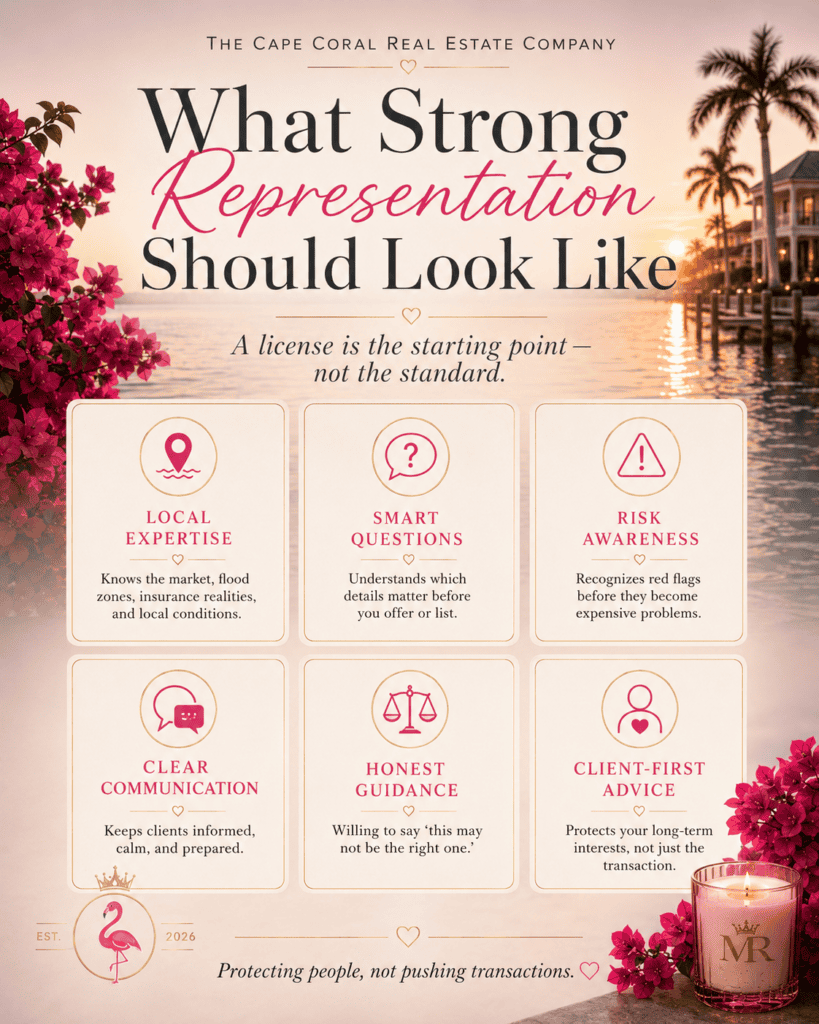
A strong agent should not pretend to know every answer.
But they should know what questions need to be asked.
They should be prepared to identify issues involving insurance, flood zones, permits, property use, rental restrictions, roof age, solar contracts, financing, inspections, and resale concerns.
They should know when to bring in the right professional—an insurance agent, lender, inspector, contractor, attorney, surveyor, or other specialist—before a client makes an expensive decision.
They should also be willing to say:
“This may not be the right house.”
“This issue needs more investigation.”
“You may want to walk away.”
That is not losing a sale.
That is protecting a client.
Questions Every Buyer or Seller Should Ask
Before choosing an agent, ask:
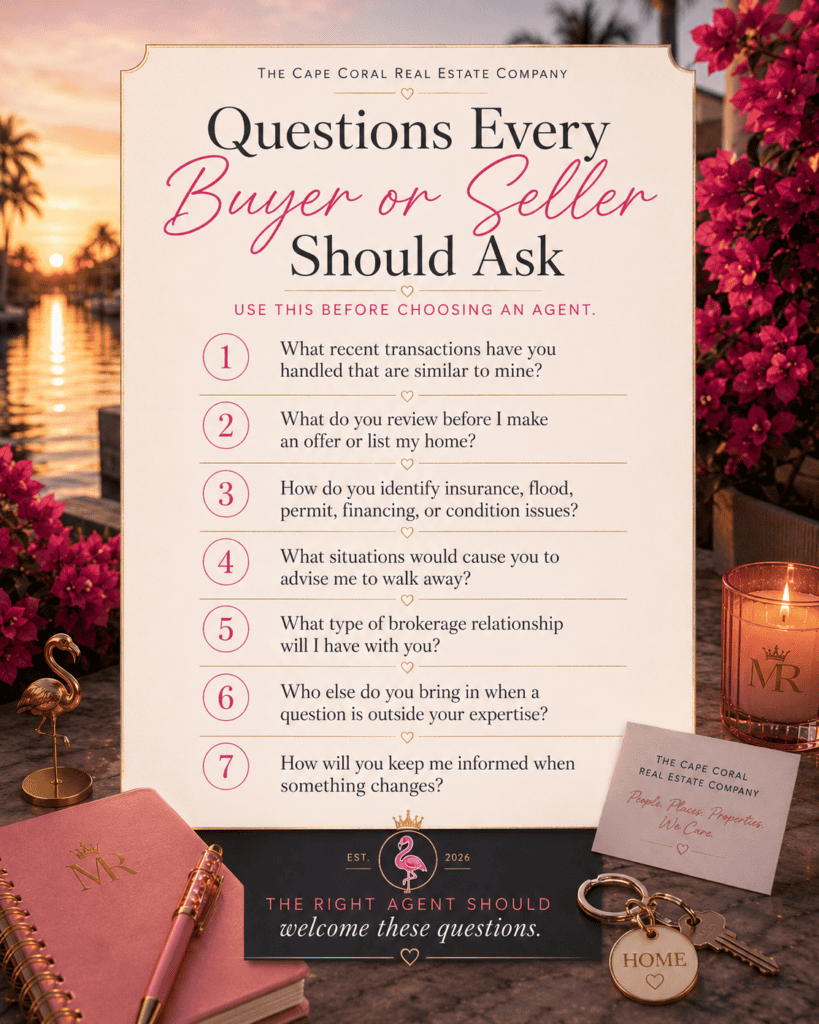
- What recent transactions have you handled that are similar to mine?
- What do you review before I write an offer or list my home?
- How do you identify insurance, flood, permit, financing, rental, or condition issues?
- What situations would cause you to advise me to walk away?
- What type of brokerage relationship will I have with you?
- Who else do you bring into the process when a question is outside your area of expertise?
- How will you keep me informed when something changes?
The right agent should welcome those questions.
It Should Be Harder
I believe real estate should be harder—not easier—to enter and remain active in.
More relevant education.
More local education.
More financial investment.
More practical experience.
More accountability.
Would that discourage people who only want to hold a license “just in case” an opportunity falls into their lap?
Probably.
Would that be better for buyers and sellers?
I believe it would.
This industry carries too much responsibility for clients to be treated like a shortcut, a side hustle, or an afterthought.
My Commitment
My mission is not to find shortcuts for people who give this industry a bad reputation.
My mission is to protect homeowners and homebuyers.
I am not a doctor or surgeon. I am not saving lives.
But I am helping people make decisions involving hundreds of thousands—or millions—of dollars.
That responsibility deserves skill.
It deserves preparation.
It deserves care.
And it deserves someone who is willing to put the client’s needs before their own.
It should be harder, shouldn’t it?
I am going to find a way to make meaningful changes.